
How to Tell Real Vertical AI From a Wrapper?
Many are horizontal AI wearing a vertical industry costume, unless you ask this simple question

Most people rely on a simple shorthand: vertical AI is purpose-built, industry-specific AI. This idea feels intuitive because it mirrors how vertical SaaS evolved. But if you look closer, the real difference between an AI wrapper and a true vertical AI product comes down to a few key factors.
Why “Vertical AI” Became a Thing
It all started when AI foundation models became capable enough and cheap enough. Every startup could call the same API, get the same intelligence, and say “we use AI.”
So companies needed a new way to sound different. “Vertical AI” became that language. Say you’re built for law firms, clinics, or underwriters, and suddenly you sound specific, focused, harder to replace than a generic chatbot.
The term didn’t spread because the AI itself got more specific. It spread because everyone needed a way to signal specificity once the underlying technology stopped being different.
The Story Everyone’s Telling Themselves
Most people are running on this shorthand: vertical AI is purpose-built, industry-specific AI.
This story feels natural because it’s exactly how vertical SaaS was built. Take a horizontal tool, like a CRM, scheduling tool, or database, and reshape the UI and workflow for one industry.
So when AI showed up, companies took a foundation model, fed it legal documents, medical records, or financial statements, wrapped it in an industry-specific interface, and called it “legal AI,” “healthcare AI,” or “finance AI.”
That’s basically horizontal AI wearing a vertical industry costume. It’s a reasonable guess. But it’s still a wrapper. And that’s why it matters.
What Actually Makes AI “Vertical”
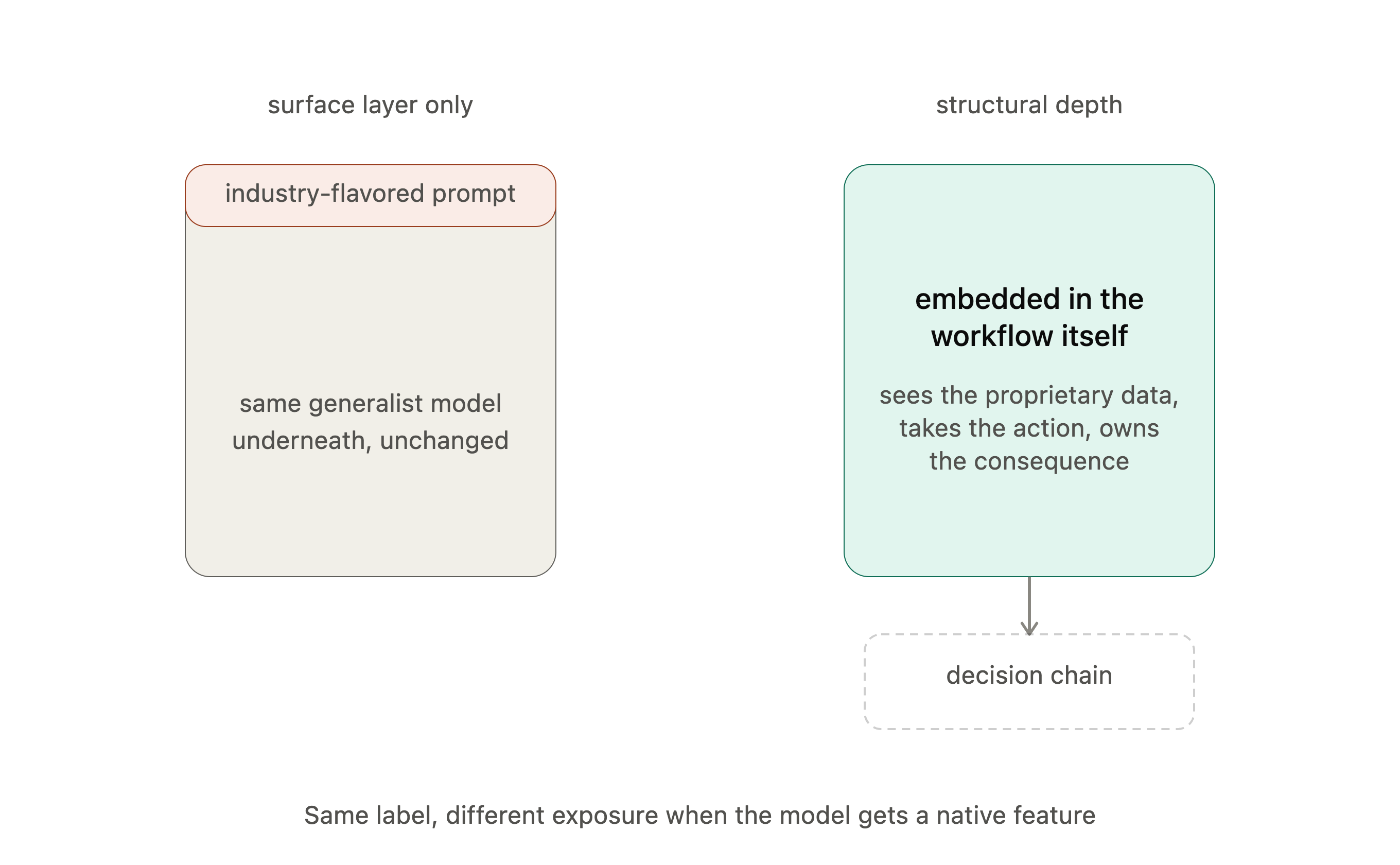
Here’s the part the surface story misses. What makes AI vertical isn’t industry or specific training data. It’s structural depth.
Once you look past the pitch, three things separate real depth from a wrapper:
Data: Proprietary enough that a competitor would need years to rebuild it
Workflow: Embedded deep enough that ripping the system out would break how the business actually runs
Trust: The track record of getting high-stakes decisions right, which took real time to earn and can’t be shortcut with a better prompt.
However, these three don't carry equal weight in every industry:
Trust matters most where a wrong call has real consequences, such as legal, healthcare, underwriting.
Data moats matter most where the proprietary information is itself the asset, not just the workflow around it.
In lower-stakes verticals, like marketing or content tooling, workflow embedding alone can be enough to create real depth, even without much of a data or trust moat.
None of these are visible in a product demo. It’s a spectrum of how deep the integration goes, from surface-level industry framing all the way to systems that are structurally inseparable from the workflow they serve.
Why This Distinction Changes How You View Companies
Here’s why this matters if you’re assessing these companies, not just using them.
If you evaluate “vertical AI” by its surface, such as industry-specific language, an industry-specific pitch, or a founder with domain credentials, you’re measuring the costume, not the structure.
A company with real structural depth has long-term defensibility. Not because the model is proprietary, since usually it isn’t. But because the integration, compliance handling, and liability absorption took real time and real trust to build. That’s not a feature you copy over a weekend.
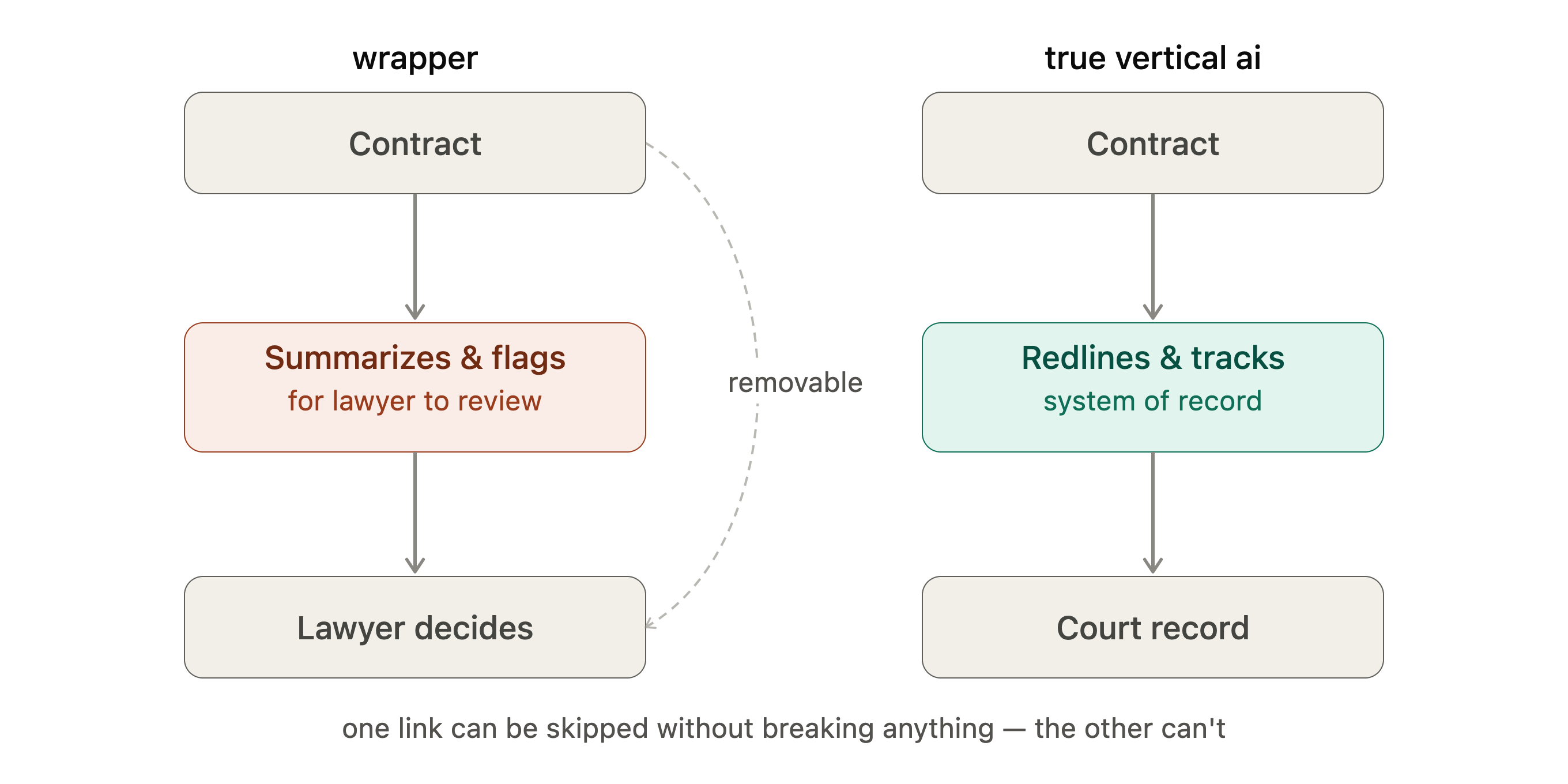
Two companies can look identical on that axis and be playing entirely different games. Take two legal AI products:
One summarizes a contract and flags clauses for a lawyer to review.
The other redlines the contract itself, tracks the negotiation history, and is the system of record (SoR) if a dispute ever goes to court.
Same label. One is an AI research assistant. The other is now part of the firm’s liability chain.
The Question Worth Asking Instead
Next time someone tells you their company does “vertical AI,” ask one thing. What breaks if you remove it, and why?
If the answer is “we lose a nice feature,” you’re looking at a wrapper. If the answer is “the business stops functioning, and nobody can rebuild what’s gone,” you’re looking at something with real depth.
That one question does more work than the label ever will. It’s not about what data trained the model. It’s about what would actually break.
Which is also why the label stopped being useful the moment everyone started claiming it. It was never wrong to use. It just stopped telling you anything, once saying it became the default instead of the exception.
More Posts Like This?
If this gave you a new perspective, a quick share or reply helps me understand what’s worth digging into next.
